

Is Nariz Masculine Or Feminine
I of the showtime things y'all'll observe out when learning Spanish is that all nouns have a gender. This ways that every time y'all utilise a substantive, you lot must express whether it'due south a feminine or masculine give-and-take. Given that this may exist a new concept for new learners, many people wonder what grammatical gender in Spanish is.
Grammatical gender is a property of Castilian nouns. This aspect allows united states of america to classify words as either masculine or feminine. In Spanish, all nouns take a gender. To keep the judgement consistent, adjectives, articles, and pronouns must agree in gender and number with the noun they modify.
Non knowing if a word is feminine or masculine in Spanish can lead to poor communication and, in some cases, misunderstandings. For that reason, in this guide, I'll provide you with all the key information you lot need to know to determine the gender of nouns in Castilian.
Here is a quick overview of the topics we'll embrace:
- How Does Spanish Gender Work
- Rules for Feminine and Masculine Words
- Castilian masculine noun endings
- Feminine nouns endings
- Spanish gender exceptions
- Ofttimes Asked Questions
- Do numbers in Spanish concord with gender?
- How do numbers and gender affect adjectives in Castilian?
- Practice colors alter gender in Spanish?
- Why is dress masculine in Spanish?
- Key Points
Past the end of this commodity, you lot'll have a more solid understanding of how Spanish gender works.
Go a Pace-by-Footstep Map to Learning Spanish
Join the Tell Me In Spanish customs and get a copy of my pace-past-stride Spanish Learner's Roadmaps and catchy synonyms & vocab cheat sheets.
How Does Spanish Gender Work
Equally a romance language, Castilian has grammatical gender whose purpose is to express whether a noun is masculine or feminine. The Castilian gender can be distinguished with certain endings or by checking the gender of the adjectives, pronouns and Spanish articles surrounding that give-and-take.
50 a cas a blanc a es muy bonit a .
The white house is very pretty.
Nuestr os perr os son pequeñ os .
Our dogs are small.
Many students assume that confusing the gender of words in Spanish is not a big bargain. In many cases, the worst that can happen to you is that your Spanish will not sound very good:
Incorrecto
La problema es que no tengo tiempo.
The problem is that I don't accept fourth dimension.
Su mano es muy pequeñ o .
His manus is very minor.
However, in certain situations, changing the gender of a noun can besides change its significant, equally you lot can see in the graphic and examples below:
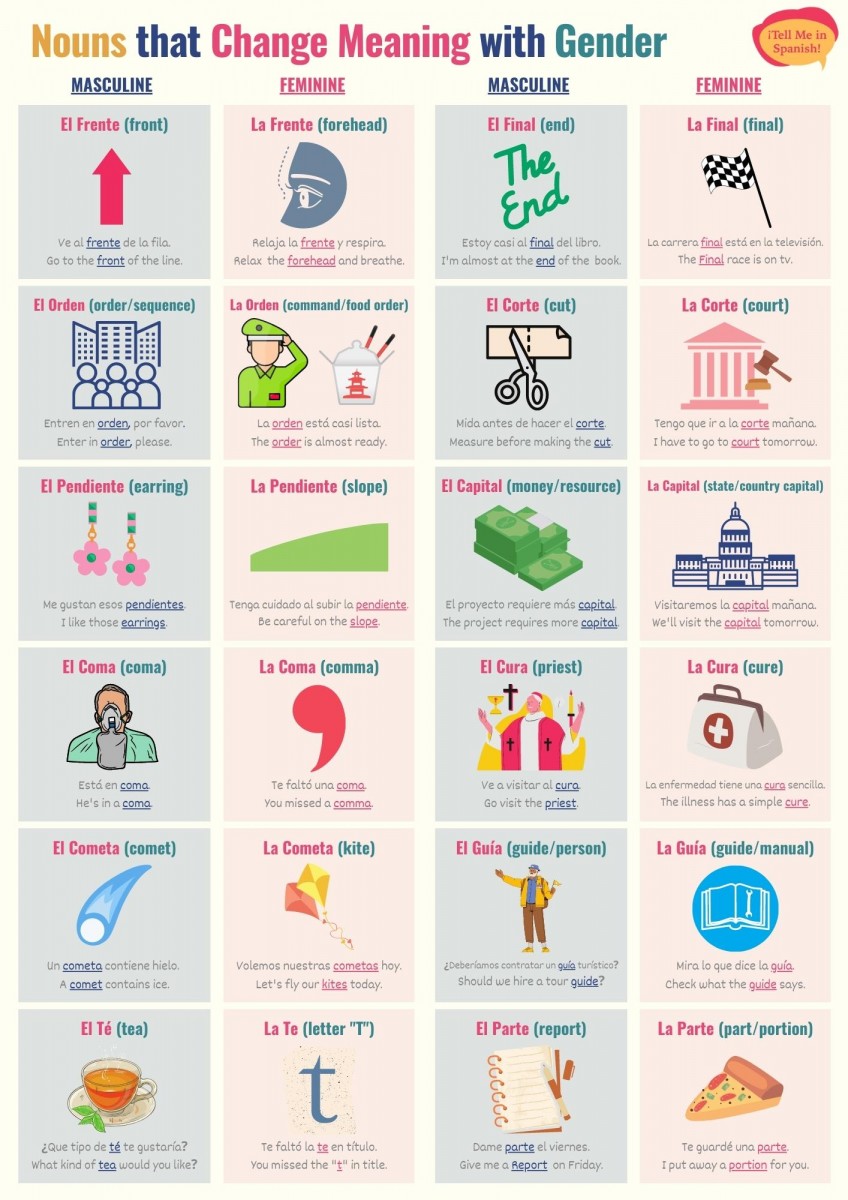
Me gustan las cerezas.
I like cherries.
Mi mamá tiene united nations cerezo.
My mom has a cherry-red tree.
Me corté la frente.
I cut my brow.
Hay un frente frío en la ciudad.
In that location's a common cold front in the metropolis.
Have Notation: The gender of a noun in Spanish affects determiners, adjectives, and some pronouns. To put it in simple terms, if yous're working with a Spanish masculine substantive, you must make sure its modifiers are too masculine.
[Determiner] + [substantive] + [verb conjugated] + [adjective]
Nuestr o coch east está suci o .
Our car is dirty.
Esta camisa es negr a .
This t-shirt is black.
Rules for Feminine And Masculine Words in Spanish
A Spanish noun is a word we use to name people, things, concepts, places, and animals.
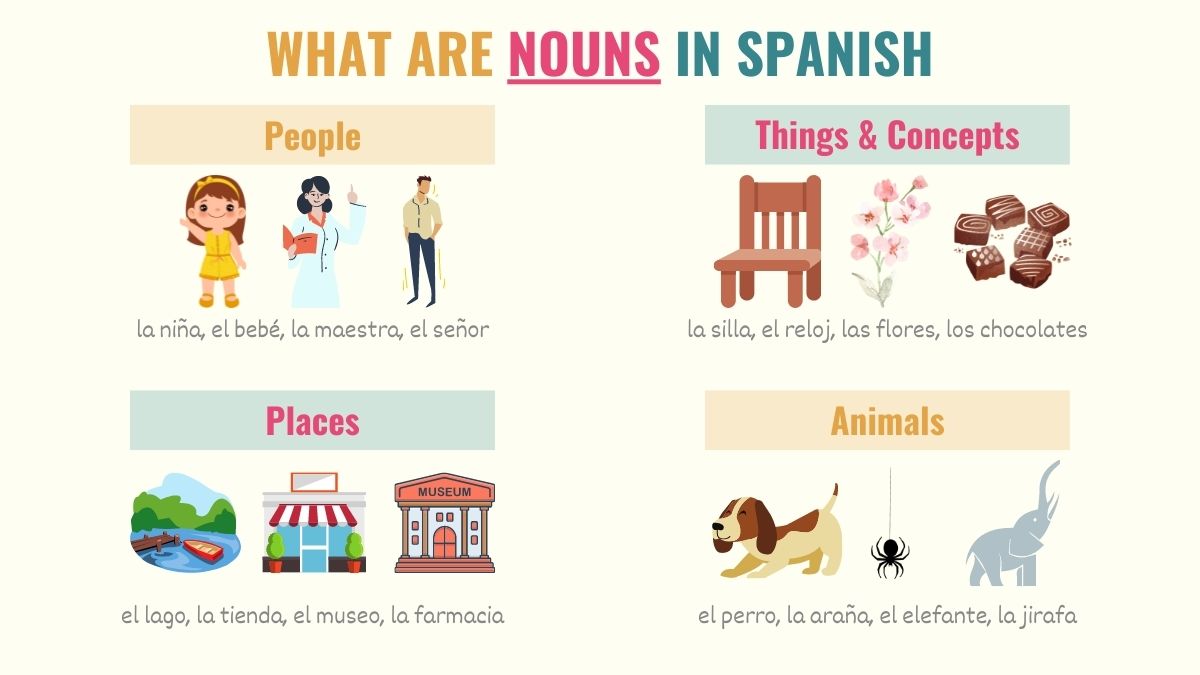
Every bit established before, a Spanish noun can be classified equally masculine or feminine depending on its gender. For living things (such as people and animals), the grammatical gender is associated with the biological gender:
El perro de Luis es blanc o .
Luis' dog is white.
Mi gatita está enferm a .
My kitty is sick.
El mecánico trabaja todos los días.
The mechanic works every twenty-four hours.
Fiftya mesera descansa los jueves.
The waitress doesn't work on Thursday.
Withal, things start getting catchy when determining the gender of objects and concepts. After all, how can you know if problema and mano are feminine or masculine? For these types of cases, there are sure guidelines that tin give yous a better idea of how Castilian gender is formed.
In the following sections, nosotros'll explore some of Castilian's near important rules for feminine and masculine nouns. Be aware that these guidelines are not set in rock, and there are some exceptions that y'all'll need to memorize. And then, we'll cover those exceptions beneath, too.
Masculine noun endings
In Spanish, the following nouns are e'er masculine:
- Cities and countries that end with a consonant.
- Countries and cities that terminate with a vowel other than 'a'.
- Names of lakes, oceans, seas, and rivers.
Cheque these examples:
(Determiner] +[noun] + [verb conjugated] + [complement]
Uruguay es muy bonit o .
Uruguay is very pretty.
Singapur es muy autoo.
Singapore is very expensive.
El Amazonas es el río más largo del mundo.
The Amazon River is the world'due south largest river.
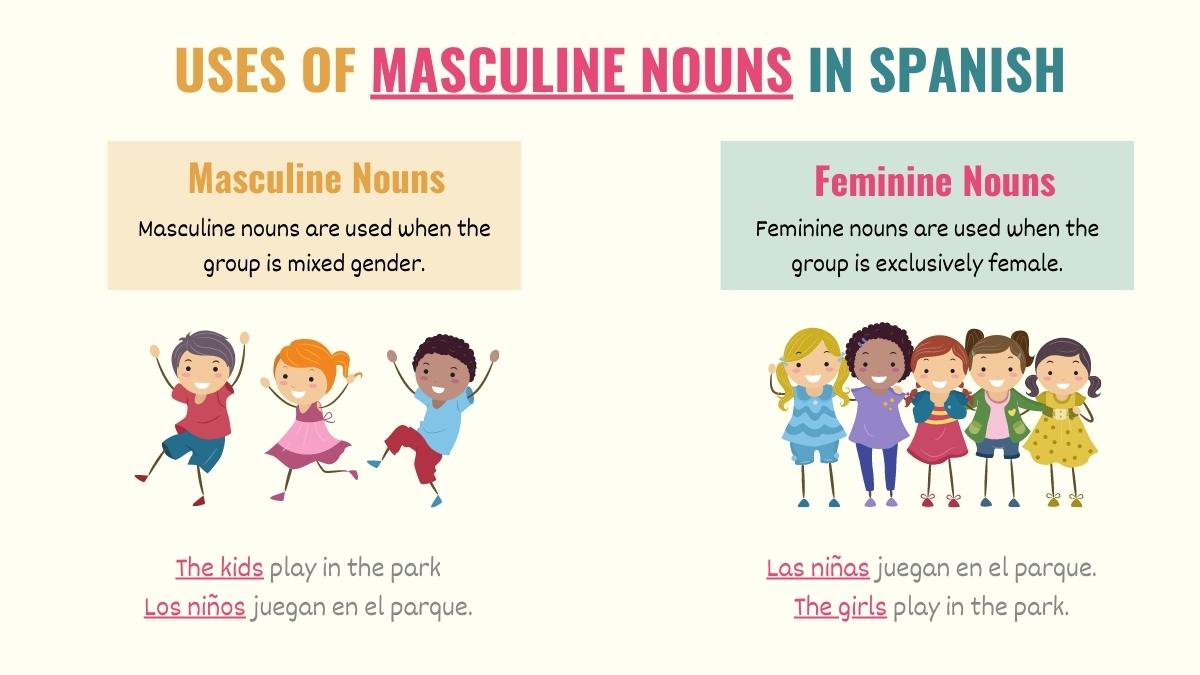
Take Note: When information technology comes to living things (people and animals), masculine nouns are e'er used when referring to a mixed grouping (no matter how many females or males are) or when talking about the grouping as a whole.
Los niñodue south juegan en el parque.
The kids play in the park.
Mis perrodue south son muy tranquilos.
My dogs are very tranquility.
In the sections beneath, y'all'll find tables with the nigh mutual endings for masculine words in Castilian. Make sure you pay attention to the exceptions column.
Masculine nouns that end in -o
As you may already know, most masculine words in Castilian end with '-o'. Simply, every bit you lot'll see in the examples below, some popular words are the exception to this rule.
| Ending | Masculine noun examples | Exceptions |
|---|---|---|
| -o | El equipo (team) | La mano (paw) La moto* motorcycle) La foto* (photograph) La radio (radio) |
| El zapato (shoe) | ||
| El dinero (money) | ||
| El café (coffee) | ||
| El accidente (blow) | ||
| El restaurante (restaurant) | ||
| El paciente (patient) | ||
| El maquillaje (make up) | ||
| El ejercicio (practice) | ||
| El beso (kiss) | ||
| El queso (cheese) | ||
| El carro (car) | ||
| El barco (boat) | ||
| El cuarto (room) |
*Note: la moto and la foto are a shortened version of the feminine words 'motocicleta' and 'fotografía'.
[Determiner] + [noun] + [complement]
El diseño de mi prima no está terminado.
My cousin's blueprint is not finished.
Sus zapatos son muy caros.
His shoes are very expensive.
El plato es blanco con rayas azules.
The dish is white with blue stripes.
Spanish Masculine nouns that end in -e
| Ending | Masculine substantive examples | Exceptions |
|---|---|---|
| -e | El juguete (toy) | La madre (mother) La gente (people) La leche (milk) La nube (cloud) La noche (night) |
| El pie (pes) | ||
| El té (tea) | ||
| El café (coffee) | ||
| El accidente (accident) | ||
| El restaurante (eatery) | ||
| El paciente (patient) | ||
| El maquillaje (make up) | ||
| El dulce (processed) |
[Determiner] + [noun] + [complement]
Quiero un té helado.
I want an iced tea.
Este restaurante es muy famoso.
This restaurant is pretty famous.
El maquillajdue east de Claudia es muy bueno.
Claudia's make-up is very good.
Masculine nouns that stop in -l
| Catastrophe | Masculine noun examples | Exceptions |
|---|---|---|
| -l | El control (remote) | La señal (sign) La cárcel (jail) La sal (salt) La moral (morals) |
| El árbol (tree) | ||
| El albañil (architect) | ||
| El ángel (angel) | ||
| El comercial (commercial) | ||
| El mantel (tabular array fabric) | ||
| El labial (lipstik) | ||
| El hospital (hospital) | ||
| El fútbol (soccer) | ||
| El manual (manual) | ||
| El hotel (hotel) | ||
| El pastel (cake) | ||
| El papel (newspaper) |
[Determiner] + [noun] + [complement]
El fútbol es muy aburrido.
Soccer is very ho-hum.
¡Qué bonito está tu labial!
Your lipstick is and so pretty!
Ese árbol es muy viejo.
That tree is very old.
Spanish masculine nouns that stop in -r
| Catastrophe | Masculine noun examples | Exceptions |
|---|---|---|
| -r | El colour (color) | La flor (flower) La mujer (woman) |
| El calor (heat) | ||
| El dolor (pain) | ||
| El sabor (flavor) | ||
| El vestidor (dressing room) | ||
| El lugar (place) | ||
| El marcador (marking) | ||
| El azar (fate) | ||
| El neckband (necklace) | ||
| El lunar (mole) | ||
| El olor (hodor) | ||
| El tenedor (fork) | ||
| El bar (bar) | ||
| El suéter (sweater) |
[Determiner] + [noun] + [complement]
El bar está lleno.
The bar is crowded.
Tu suéter es rojo.
Your sweater is blood-red.
El vestidor está ocupado.
The dressing room is occupied.
Masculine nouns that end in -due north
| Ending | Masculine noun examples | Exceptions |
|---|---|---|
| -northward | El avión (plane) | La imagen (image) Words catastrophe with -ión. |
| El abdomen (belly) | ||
| El bastón (pikestaff) | ||
| El sartén (pan) | ||
| El delfín (dolphin) | ||
| El huracán (hurricane) | ||
| El pulmón (lung) | ||
| El orden (order) | ||
| El tiburón (shark) | ||
| El sillón (couch) | ||
| El volumen (volume) | ||
| El salmón (salmon) |
[Determiner] + [noun] + [complement]
Los delfines son adorables.
Dolphins are adorable.
Me encanta el salmón ahumado.
I love smoked salmon.
Este sillón es muy cómodo.
This couch is very comfortable.
Spanish masculine words ending with -z
While virtually nouns that end with a particular consonant or vowel are generally classified equally either masculine or feminine, nouns that end with 'z' do non follow a guideline. This is the simply noun ending that does not accept a guideline gender nomenclature. Therefore, yous merely need to memorize the gender of words that finish with 'z'.
| Ending | Masculine substantive examples |
|---|---|
| -z | El lapiz (pencil) |
| El tapiz (wallpaper) | |
| El pez (fish) | |
| El arroz (rice) | |
| El maíz (corn) |
[Determiner] + [noun] + [complement]
El maíz está crudo.
The corn is raw.
El pez es negro.
The fish is black.
Take Note: To pluralize these Spanish words, you must change the '-z' for the catastrophe '-ces'.
Los peces son muy bonitos.
Fish are very pretty.
Feminine nouns endings
In the tables beneath, y'all'll find the most mutual endings for feminine words in Spanish.
Feminine nouns ending with -a
The ending '-a' is a good indicator that you're most likely dealing with a feminine Spanish word. However, this doesn't mean that all words that end with an '-a' are feminine. In fact, a few masculine words also end with this vowel.
| Ending | Feminine noun examples | Exceptions |
|---|---|---|
| -a | La lata (can) | El día (day) El mapa (map) Words that finish in '-ma' such as: El problema (problem) El sistema (system) El idioma (language) El clima (whether) El programa (program) |
| La cama ( bed) | ||
| La taza (cup) | ||
| La lluvia (rain) | ||
| La escuela (schoolhouse) | ||
| La camisa (t-shirt) | ||
| La botella (bottle) | ||
| La guitarra (guitar) | ||
| La rama (co-operative) | ||
| La palma (palm) | ||
| La broma (joke) | ||
| La pluma (pen) |
[Determiner] + [noun] + [complement]
La comida estuvo muy rica.
The food was delicious.
Estas manzanas están muy agrias.
These apples are very sour.
La botella de Suzy está vacía.
Suzy's canteen is empty.
When referring to people or animals, most of the time Spanish nouns can be transformed into feminine words by simply replacing the '-o' with an '-a'.
La maestra tiene dos gatitas.
The teacher has two kitties.
Tu vecina es muy ruidosa.
Your neighbor is very noisy.
Accept Notation: Do not get mixed up! You lot'll discover a few Spanish singular feminine words that end with '-a' that are preceded past a masculine article. We only do this when those words offset with a stressed 'a' sound. This allows united states of america to ease the pronunciation!
El agua está fría.
The h2o is cold.
Las aguas azucaradas son malas para la salud.
Sugared water is bad for your wellness.
Because 'aguas' is plural in the second example, the 'southward' on the finish of the article 'las' breaks upward the stressed 'a' in 'aguas'. Which is why it uses the article 'las' which correctly matches the noun's gender.
Spanish feminine nouns ending with -ión
As y'all learned before, many Spanish masculine words end with '-northward'. Only if y'all paid shut attention to those words, you lot may have noticed that none of them had the suffix '-ión':
El balcón es muy grande.
The balcony is very big.
El patín eléctrico es muy práctico.
The electrical scooter is very practical.
Why? Because all the nouns that finish with '-ión' are feminine words in Spanish.
| Ending | Feminine noun examples | Exceptions |
|---|---|---|
| -ión | La mansión (mansion) | NONE |
| La canción (song) | ||
| La decisión (decision) | ||
| La colección (collection) | ||
| La televisión (Television set) | ||
| La imaginación (imagination) | ||
| La opción (pick) | ||
| La conexión (connection) | ||
| La natación (swimming) | ||
| La habitación (room) |
La canción es muy larga.
The song is too long.
Su habitación es morada.
Her bedroom is royal.
Tomó la decisión equivocada.
He made the incorrect decision.
Castilian feminine nouns ending with -ad
Other nouns that are e'er feminine are those words that end with '-advertizement' or '-ed'.
| Catastrophe | Feminine noun examples | Exceptions |
|---|---|---|
| -ad / – ed | La felicidad (happiness) | NONE |
| La due southed (thirst) | ||
| La verdad (truth) | ||
| La mitad (half) | ||
| La amistad (friendship) | ||
| La cualidad (quality) | ||
| La autoridad (dominance) | ||
| La lealtad (loyalty) | ||
| La facultad (faculty) | ||
| La pared (wall) |
[Determiner] + [noun] + [complement]
La pared está recién pintada.
The wall is newly painted.
Lucía tiene cualidades muy buenas.
Lucia has very nice qualities.
La verdad puede ser dolorosa.
The truth can be painful.
Spanish feminine nouns ending with -z
Remember that nouns that end with 'z' do non follow a default gender guideline. So, it's important to memorize the feminine words that end with the consonant 'z'.
| Ending | Feminine noun examples |
|---|---|
| -z | La voz (voice) |
| La nuez (nut) | |
| La cruz (cross) | |
| La luz (light) | |
| La vejez (old age) | |
| La paz (peace) | |
| La nariz (olfactory organ) |
[Determiner] + [noun] + [complement]
Su nariz es pequeña.
His olfactory organ is small.
Tu voz es muy chillona.
Your voice is so high-pitched.
La luz es bastante brillante.
The light is quite vivid.
Spanish gender exceptions
So far, you've learned some of the near mutual endings used to course feminine and masculine words in Spanish and their exceptions. In improver to these anomalies, there are other Spanish gender exceptions that y'all must keep in heed.
Irregular nouns that change depending on the gender
In Spanish, some nouns use different words for the masculine and feminine forms. These nouns are:
| Spanish masculine noun | Castilian feminine noun | Translation |
|---|---|---|
| Caballo | Yegua | Equus caballus / Mare |
| Toro | Vaca | Bull / Cow |
| Yerno | Nuera | Son / Daughter in law |
| Papá | Mamá | Dad / Mom |
| Cura | Monja | Priest / Nun |
| Hombre | Mujer | Man / Woman |
| Caballero | Dama | Gentleman / Lady |
| Carnero | Oveja | Sheep |
| Histrion | Actriz | Role player / Actress |
Mi caballo es negro y mi yegua parda.
My horse is black and my mare brownish.
El toro es muy agresivo y la vaca muy tranquila.
The bull is very ambitious, and the cow is very calm.
Nouns with immutable endings
Every bit established before, when it comes to people, you can usually form the Castilian gender by irresolute the '-o' for an '-a'. Yet, at that place are certain words whose endings are unalterable.
Lookout man out! Many people learning Spanish assume that these are neutral nouns. But as you lot already know, there is no such thing as neutral nouns in Spanish. With these types of nouns, yous even so have to mark the gender. To do so, you'll use Spanish articles, adjectives, or pronouns.
These are some of the nouns whose endings cannot change. As you can see, most of them are nouns used to describe a person's profession or occupation:
| Spanish | English |
|---|---|
| Turista | Tourist |
| Estudiante | Student |
| Periodista | Announcer |
| Juez | Judge |
| Astronauta | Astronaut |
| Paciente | Patient |
| Cantante | Singer |
| Dentista | Dentist |
| Cliente | Customer |
| Agente | Agent |
| Piloto | Airplane pilot |
| Testigo | Witness |
| Conserje | Concierge |
And here are some examples of what you can do to mark the gender of these words:
[Masculine or feminine determiner] + [noun]+ (adjective)
Esa cantante es muy talentosa.
That vocalizer is very talented.
Esos cantantes son españoles.
Those singers are Spanish.
La juez es muy puntual.
The judge is always on fourth dimension.
Los dentistas están muy jóvenes.
The dentists are very young.
El periodista trabaja todo el día.
The journalist works all mean solar day.
La periodista es muy insistente.
The journalist is very persistent.
Take Note: You can likewise imply the gender of these nouns by saying the proper name of the person you're talking about.
José es dentista.
José is a dentist.
Oftentimes Asked Questions nearly Spanish Gender
Spanish gender is a complex topic. As a upshot, here are some often asked questions that most of my students usually have.
Practice numbers in Castilian concur with gender?
When working equally adjectives, numbers accept to agree in gender and number with the noun they are modifying. As a issue, depending on the noun, a number can be either feminine or masculine. This rule is only applicable to the post-obit numbers:
- One ( uno)
- Hundreds (starting at two hundred)
Tengo doscientos pesos.
I have two hundred pesos.
Encarga doscientas galletas.
Society ii hundred cookies.
Tengo una pluma extra.
I have an extra pen.
Quiero united nations café, por favor.
I want a coffee, please.
Hubo mil quinientos invitadbone.
In that location were m v hundred guests.
As mentioned above, this rule comes into effect with amounts superior to 2 hundred. Therefore, it'south correct to say:
Tengo cien pesos.
I have ane hundred pesos.
Hay cien sillas disponibles.
There are 1 hundred chairs available.
How practice number and gender affect adjectives in Spanish?
Nigh Castilian adjectives must agree in gender and number with the accompanying noun. This means that nigh Castilian adjectives will change their gender to lucifer the noun. Adjectives that end with an '-e' or a consonant cannot exist modified to express the Castilian grammatical gender.
Sofía es muy inteligente .
Sofia is very smart.
Mi primo también es inteligenteast .
My cousin is also smart.
Tu casa es me y bonita .
Your business firm is big and pretty.
Ese color es bonito.
That color is pretty.
Do colors change gender in Spanish?
If a color is working as a Spanish adjective, it volition need to alter its gender to concur with the noun unless such a color ends with a consonant or '-e'. On the other mitt, when working as nouns, Spanish colors are always masculine.
Bank check these examples of sentences with colors in Castilian:
El rosa es mi colour preferido.
Pinkish is my favorite color.
La camisa rosa es muy grande.
The pinkish t-shirt is too big.
Quiero un rojo más intenso.
I want a more than intense reddish.
La mochila roja me gusta más.
I similar the ruby-red pocketbook more.
Why is dress masculine in Castilian?
Many people mistakenly think the gender of a noun in Spanish is determined by who uses that object. Because of this, most people assume that vestido is feminine, only to detect out that they're wrong. As explained before, a big portion of masculine words in Spanish end with an '-o'. Therefore, vestido (dress) is really a masculine noun.
Wrong
Me gusta la vestido rosa.
I like the pinkish dress.
Right
Me gusta el vestido rosa.
I like the pink dress.
Key Points: Masculine & Feminine Words in Castilian
Castilian gender can be a challenging topic for many new and advanced learners. For that reason, this guide covers all the information yous need to understand this topic. Here are some fundamental points that you should keep in mind most masculine and feminine words in Spanish:
- Castilian grammatical gender allows you to classify words into masculine and feminine.
- For objects and concepts, Spanish gender is determined based on certain endings.
- People and animals' gender is based on their biological gender or their gender identity.
- The gender for people and animals can be formed by replacing the '-o' with an '-a' or vice versa.
- Grammatical gender affects adjectives, articles, and Spanish determiners. This means that these words must agree in gender and number with the noun.
- The Spanish masculine gender tin be used to talk about a mixed grouping or to refer to the group equally a whole.
- Most Spanish masculine words end with '-o', 'l', 'e', 'r' and 'n'. However, some feminine words as well have these endings. For example, la razón, la mano, and la mujer.
- Most feminine words in Spanish end with '-a', '-ión', '-ad', '-ed'. There are also some exceptions, such as el día and el mapa.
- Singular feminine words that beginning with a stressed 'a' sound must be preceded by a masculine article. Since this is only washed for pronunciation purposes, the word remains feminine.
- Certain nouns related to professions take fixed endings. In these cases, we use manufactures, adjectives, and pronouns to marking the gender.

Is Nariz Masculine Or Feminine,
Source: https://www.tellmeinspanish.com/grammar/spanish-gender/
Posted by: cuellarwinget.blogspot.com
0 Response to "Is Nariz Masculine Or Feminine"
Post a Comment